How to Remove an Image Background for Free With AI in Your Browser
Removing an image's background used to require hours of manual selection in complex programs. Today, in-browser AI lets you cut out subjects with pixel-level precision in seconds.
1. The Advantages of Local AI Background Removal
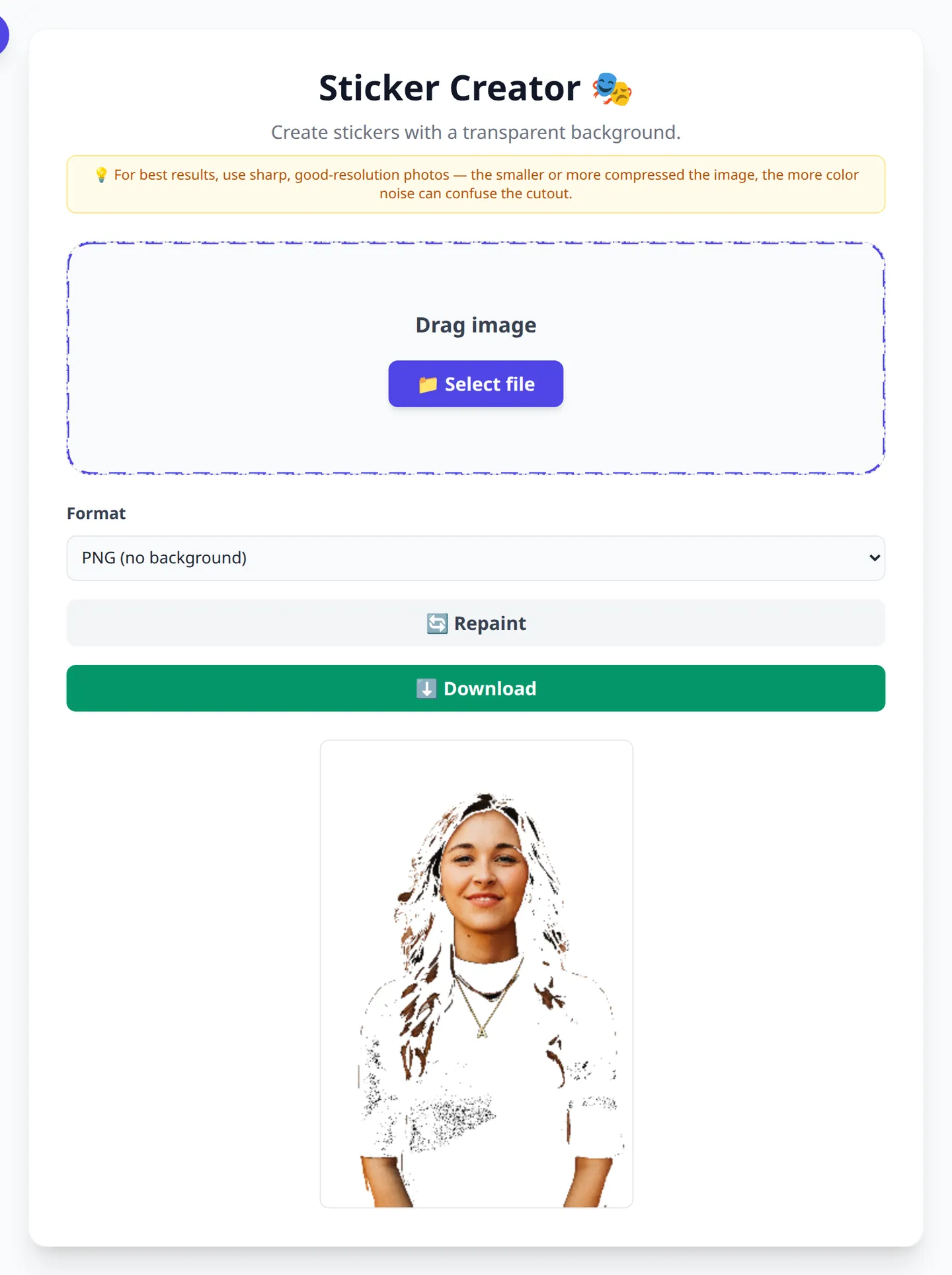
Processing the cutout with machine learning models running locally guarantees absolute privacy for photos of unreleased products or corporate portraits. OmniPixy's Sticker Creator tool runs this AI segmentation right in your browser, with no image ever uploaded to a server.
Got a photo with a background you don't want?
Remove the background with AI, clean up the edges with a brush, and download the transparent PNG. All in your browser: the photo is never uploaded.
Remove my photo's backgroundThere is also a dedicated page: remove background.
A Detailed Guide to Performance and User Experience
Web performance in 2026 is one of the most decisive pillars for the success of any digital strategy. When a user opens a page on a mobile device or a connection with limited coverage, every millisecond of delay in downloading media assets exponentially increases the chance they'll leave. Optimizing images isn't just about saving server space — it's about delivering a smooth, instant experience to every visitor.
Local processing through browser-based tools like the OmniPixy suite makes a fundamental difference compared to traditional platforms. By running all compression, conversion, and resizing algorithms 100% natively on your device via WebAssembly and modern JavaScript, your confidential photos and documents are never transmitted to third-party servers, keeping you in full control of your privacy.
Core Principles for Visual Optimization
- Exact dimension matching: Always export the image at the maximum resolution the on-screen container will actually need. Avoid uploading 4000-pixel photos for an 800-pixel space.
- Strategic format selection: Use WebP and AVIF for everyday web design thanks to their superior compression, and reserve JPG for guaranteeing compatibility with older tools or physical printing.
- Accessibility metadata: Write clear, contextual alt text to improve search engine rankings and ensure accessibility for screen-reader users.
- Standard color profile preservation: Confirm your files use the sRGB color space to prevent visual tones from shifting when displayed on different monitors or mobile screens.
W3C Standards and the Future of Digital Imagery
With the rapid evolution of OLED mobile screens and high-resolution 4K/8K monitors, the standards defined by the W3C consortium for web graphics increasingly emphasize adaptive visual experiences. Adopting optimized workflows through OmniPixy's local tool suite ensures your website strictly meets the accessibility, internationalization, and response-speed recommendations demanded by leading search engines.
Advanced Media Optimization and Web Performance Strategies
In the highly competitive 2026 web landscape, efficiently delivering visual assets isn't just good development practice — it's a make-or-break requirement for commercial success and organic ranking. Search engines like Google decisively prioritize websites that deliver smooth experiences, minimal response times, and strict compliance with Core Web Vitals metrics.
By using OmniPixy's local tool suite, all graphic processing (format conversion, smart compression, dimension adjustment, and metadata cleanup) happens directly in your own browser's RAM using technologies like WebAssembly and the Canvas API. This eliminates any dependency on external servers, guaranteeing maximum execution speed while protecting the privacy of your files and personal photos 100%.
Essential Best Practices for Webmasters
- Adaptive resizing: Define responsive containers and export images at the exact dimensions needed for mobile and desktop screens.
- Next-generation formats: Adopt WebP and AVIF to reduce your visual assets' weight by up to 80% compared to traditional JPG.
- Accessibility and alt markup: Include clear, natural alt text descriptions on every image to improve SEO indexing and accessible navigation.
- sRGB color standardization: Confirm your photos use the sRGB color space to avoid tone discrepancies across monitors from different manufacturers.
Frequently Asked Questions (FAQ)
Does it handle hair or difficult edges well?
Reasonably, but not perfectly: on loose hair and textured fabrics it tends to leave fringes or cut too much. Check it at 100% before publishing, especially when the new background is a different colour.
Is my photo uploaded to a server to remove the background?
No: the model runs in your browser and the image never leaves your machine. The first run takes a little longer because the model has to download; after that it stays cached.
Which format should I save a transparent image in?
PNG or WebP. JPG has no transparency support: save as JPG and the background is filled with white or whatever colour you pick, which works for a product listing but not for compositing.
To remove a photo's background right now, go straight to the tool page: Remove an image background.
Conclusion
Maintaining an optimized visual strategy with the OmniPixy suite is the best technical decision to ensure lightning-fast loading, maximum privacy, and the best possible SEO ranking.
AI can also colorize old black and white photos, with equally impressive results.