Product photos for Amazon, Etsy and Shopify: what each one requires
Selling online starts with a photo that passes the marketplace filter. Amazon demands a pure white background and a specific crop, Etsy rewards photos with context, Shopify imposes nothing but weight costs you sales. These are the real rules for each platform and how to meet them without building a studio.
1. The main photo decides whether they buy
In a results listing your photo competes with twenty others in a two-centimetre thumbnail. The winner is not the prettiest: it is the one that reads at a glance. Clean background, centred product, no text on top, no odd shadows. Everything else is secondary until someone opens the listing.
That is why marketplaces are so strict about the main image and so relaxed about the rest. The main image is a technical requirement; the others are marketing.
2. Amazon: pure white background and tight crop
Amazon is the strictest and generates the most rejections. The main image rules:
- Pure white background (RGB 255, 255, 255). A greyish white or a wall with shadow does not count.
- The product fills at least 85% of the frame. Not 60% with air around it.
- No text, logos, watermarks or added borders on the main image.
- No props that are not included in the sale.
- At least 1000 px on the longest side so the zoom activates.
- JPEG, PNG or TIFF; JPEG weighs the least.
The 85% rule is the one most often broken. People shoot the product in the middle of a table and leave it small in the frame. You have to crop until the product almost touches the edges, with a minimal margin.
Amazon changes these rules fairly often and applies different requirements by category. Always confirm in your category's style guide before uploading a whole catalogue.
3. Etsy: photos with context sell more
Etsy is the opposite. The main image should still be clean, but the platform rewards photos with context: the product in use, on a wooden table, in natural light. The reason is that on Etsy people buy craft and gifts, not technical specification.
The structure that works best on Etsy is a clean first photo on a neutral background and, from the second on, the product in context, at scale (with a hand or a known object) and in detail. Etsy recommends images of at least 2000 px on the longest side.
4. Shopify: no rules, one hidden cost
Shopify imposes no image requirements. That does not mean it does not matter: every extra kilobyte on a listing is another second of load time, and on mobile that turns into abandoned carts. The practical recommendation is 2048 px on the longest side, JPEG at quality 80-85 and under 200 KB per image after compression.
Here the tool that matters is not the one that crops, it is the one that compresses. A listing with ten photos of 2 MB each is 20 MB the visitor downloads before seeing the price.
5. Getting the white background without a studio
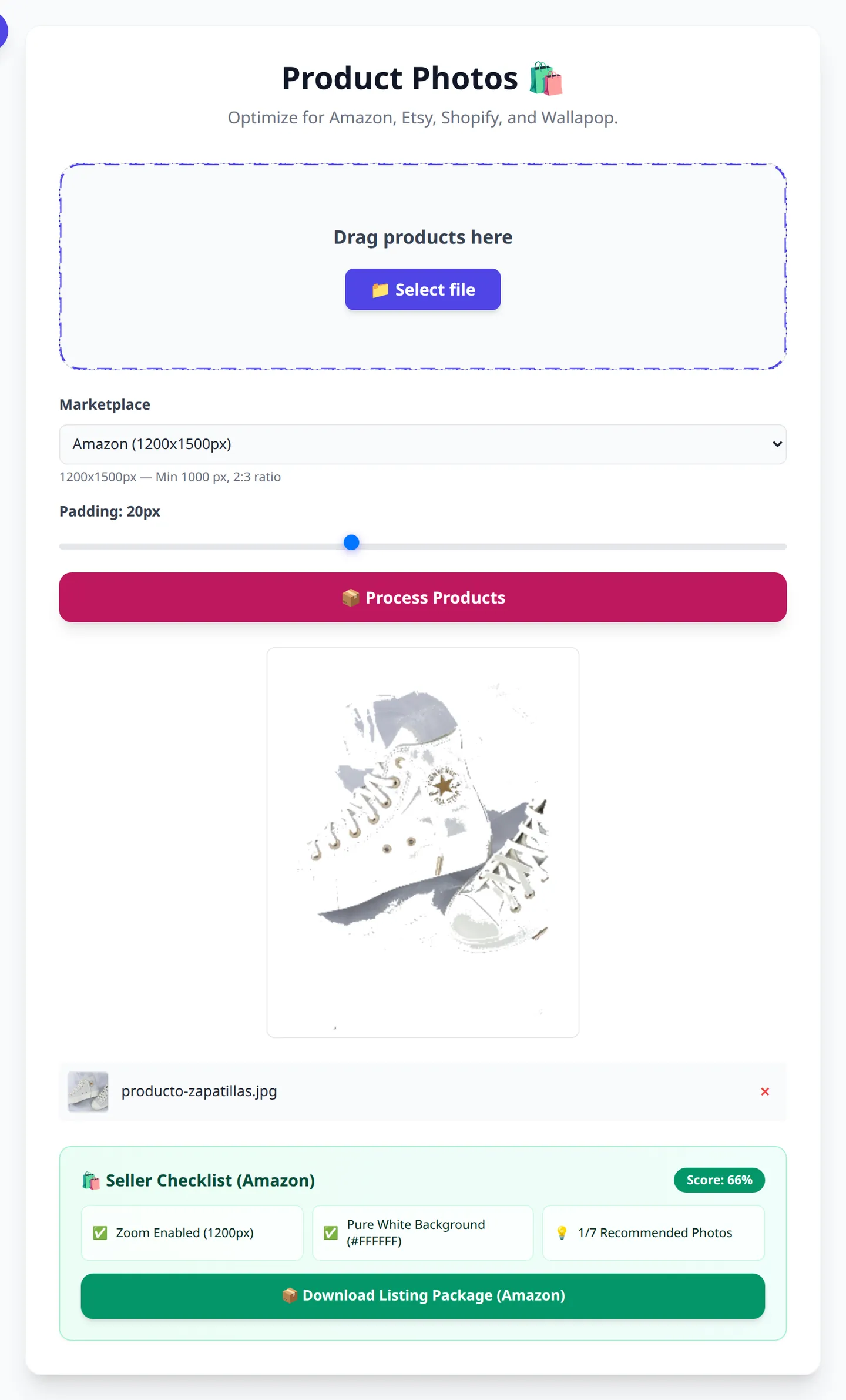
A pure white background does not require a cyclorama. It requires removing the background and putting white behind, which is what the AI cutout tool in the browser does. The process:
- Shoot the product in diffused light on a flat surface, even if it is not white.
- Open the background remover and upload the photo.
- Replace the transparent background with pure white.
- Crop so the product fills 85% of the frame.
- Export as JPEG at 2000 px on the longest side.
Everything happens in your browser, so unreleased product photos never touch a server. If you sell prototypes, that matters.
6. Photo order matters
The second photo is not decoration: it answers the doubt that blocks the purchase. The order that works in almost every category:
- Product alone, clean background, tight crop.
- Product in use or in real context.
- Detail of texture, finish or stitching.
- Scale: the product next to something the buyer knows.
- Contents or measurements, if relevant.
- Remaining colour or size variants.
Prepare your product photos
Crop, remove the background and compress in the browser. No signup, nothing uploaded.
Open the product photo editorFrequently Asked Questions (FAQ)
What background does Amazon require exactly?
Pure white, RGB 255, 255, 255, on the main image. A greyish white or one with shadow gets rejected. Secondary images allow other backgrounds.
How much of the frame should the product fill?
At least 85% on Amazon. It is the most commonly broken rule because people leave too much air around the product.
Can I put text on the main image?
Not on Amazon: the main image allows no text, logos or watermarks. Secondary images do, and so does Etsy.
How large should Shopify images be?
Under 200 KB per image after compression, at 2048 px on the longest side. Weight affects speed and speed affects sales.
Are my photos uploaded to a server?
No. Cropping and compression run in your browser. The image never leaves your computer.
Conclusion
Every marketplace has its own rule and its own audience. Amazon wants a pure white background and the product at 85%; Etsy wants context; Shopify wants the listing to load fast. All three are met with the same well-prepared photo, without uploading it to any server.